


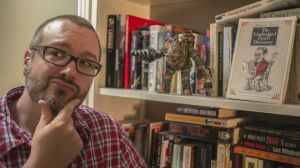
 David McRaney’s Blog, You Are Not So Smart, led to a book of the same name, published in October 2011 — a book that became a bestseller in 13 languages (we profiled him here when the book was first announced).
A follow-up volume, aptly titled You Are Now Less Dumb, hit bookshelves yesterday. Learn more about the book, the blog, and how David connects the dots between them — and how being less dumb has affected his life and work.
What was the response to the first book?
 It was . . . overwhelming. A whole new audience saw the book in stores from coast to coast and came to the blog. They shared links and started tweeting and putting posts on Facebook. That led to another wave of people checking out the book, and so on, and it kept spiraling.
Soon, I was getting emails from around the world, from high school kids in Kansas to an 80-year-old priest in Ireland. It was amazing, and scary for a while, once I realized that what started as a blog post I wrote during my lunch break had become a book sitting in stores in places that I may never see or visit. Within a few months it was picked up by new publishers, and it’s now an international bestseller in 13 languages.
Did you change your blog at all in light of the first book’s success?
I’ve changed the format to be a mix of longform, researched articles, and podcasts that include lighter posts as accompaniment. I want people who enjoyed the book to keep getting fresh content from me as I try and one-up myself, but I also want to please people looking for short-form content to read while browsing the web, and the podcast is a really fun ongoing experiment into producing something that’s easy to consume on the go.
The overall tone is still the same and the focus hasn’t changed, but I take each post very seriously now knowing my audience has expanded so much.
Tell us about the new book — how will it help us build ourselves back up after the first book revealed our inadequacies?
 The common thread in the new book is that the scientific method is a tool that human beings invented to be less dumb, and you don’t need to be a scientist or even be well-versed in scientific knowledge to use it to deal with your biases and fallacies. I showcase different forms of self-delusion and the research that discovered them, but unlike the first book, I offer some advice from scientists on how best to avoid those delusions (or at least live with them in a way that minimizes harm and maximizes happiness).
The title not only mirrors the first book’s title, but suggests that while you can never fully rid yourself of delusional thinking, you can learn to identify it, plan for it, and mitigate its effects in your daily life.
Do you use the blog as a test ground for potential book content?
I definitely still use the blog to write new topics and share them. About half of new book is expanded and re-written material I wrote for the blog after the first book, and the other half is completely new.
Was the second book easier to write?
It was actually much harder to write, because I was determined to make it better than the first book. Writing anything worthwhile gets more difficult each time you attempt it, and I want to always be able to look back at my old work and cringe because that means that I’m getting better. As David Rakoff once said of writing, “it is never easy, and it gets harder.”
(In addition to that, a tornado destroyed our house with us inside it during the editing, so that made finishing the book . . . challenging.)
Despite it being harder to write, it was much easier to organize and research. I learned a lot about how to construct a book and how to prepare beforehand from writing the first one.
Tell us about scoring and negotiating the second book deal.
I had several ideas for a second book, and those might become books in the future, but my publisher, Gotham, was so pleased with the reception of You Are Not So Smart that I was offered a sequel right away. They immediately understood what I was doing with both the blog and the first book, and we have a great relationship now. Proposing the second book, editing it, and promoting it has been painless thanks to their support.
 What do you wish you had known before diving into books?
There’s a fallacy I write about in the book called the “sunk cost fallacy,” and it’s the tendency we all have to try and salvage an obviously losing situation by investing deeper instead of just abandoning it and starting over. Wars have been lost because of it. It’s tough to do when the stakes are high.
It’s especially tough to do during a creative pursuit, especially if you are under a deadline, but I finally understood in the middle of writing that if you must be willing to delete, erase, and reboot every aspect of your project or you’ll waste days trying to save something that’s never going to work.
As you see your book come together, about 100 or so pages in, you start to see the themes and threads emerge that will eventually hold it together as a single statement. That’s when you’ll be forced to start over in some places, to rewrite and rearrange and maybe even delete and erase. You’ll resist this, because it was so hard to write everything up to that point, and there are so many awesome sentences here and there that you want people to read, but you must do it.
Any words of wisdom for bloggers aspiring to traditional publishing?
If you want to write a book, go ahead and start writing online about the topic you want to explore. Give people a chance to become fans of your work and style, and give yourself a chance to develop your voice. Publishers are much more likely to give someone a chance if a project already has a following and the person behind it has demonstrated a strong work ethic.
You’ll still need some luck and some savvy when it comes to self-promotion, but if you are making great things, you have a much better chance of getting noticed by someone who can change your life.
How has realizing how not smart you are affected your own life and work?
I’ve learned that there is a lot more to gain from proceeding from a place of humility. When you write about science you can start to believe you’ve become an authority on your subject matter, and I think that’s a dangerous place to be as a journalist — you’ll end up assuming you understand a topic you’ve yet to fully explore.
You should always assume ignorance and work to be a good explainer and interviewer, but remember that you are not an expert; you are communicating the work of experts. Self knowledge gives me the chance to improve my behavior and my work, but it does so by identifying the source of my struggles, not necessarily eliminating the struggle itself.
Look for David’s book on shelves, and get a weekly dose of reality at You Are Not So Smart.
You may also enjoy these related posts:
 WordPress.com News
Delightful! Congratulations on the book. Thanks for sharing your wisdom. Ah…editing. It’s what makes good writing, great, painful though it may be.
“the sunk cost fallacy”, You put it into words my thoughts, as I dive deeper into developing one character over another. What I am finding… I like this character so much, I wonder when will I get back to my original story-line. If I keep this up my novel will be five-hundred pages or more. Then I ask myself when do I start deleting? smh Thank you, for sharing your awesome story, Wishing you continued success.
LOL, your title alone had me hooked. Great piece, now I have to search your archive for how to score the first book deal!
THANK YOU!
Sarah
I am on a journey to grow as a writer and have only recently gained enough confidence in my blog to publicize it. My next step is to eventually write a book. I’m proud of David for making the transition from blogger to bestseller… gives me some hope I can get there some day 🙂
Congratulations…. I have just start blogging and your words of wisdom have motivated me more… Will try and start writing online.
You are an example of how old and new technologies can complement each other not be in competition.
congratulations! I especially liked your comments on “kill your darlings.” I forget which author said that, but it is a necessary evil. Louisa
I’m so happy with my 3750+ followers mostly gained in the last year, and there you are with ten million plus. Reality check! lol Congratulations on the success of book and blog both!
Congratulation. A very encouraging read. Sar
Awesome, congrats on the sequel. I have not read either one, but am going to pick them up thanks to this article:)
Thanks for sharing,
Jim
Excellent insights, thank you.
“If you want to write a book, go ahead and start writing online about the topic you want to explore. Give people a chance to become fans of your work and style, and give yourself a chance to develop your voice.”
As a new blogger, I really appreciate this advice. People have been telling me not to worry so much about how many readers I have and just write from the heart on my topic. I’m still developing my voice and learning to be patient.
I think it’s great how you stayed with WordPress after all of your publishing success! Congrats.
Thanks for the tips. I love the “sunk coast fallacy”. Way to often, both on a national level, state level and personal level, we all hate to stop and start over, even when it’s the shortest way to get where we need to go.
very good writing. clear, lucid, humble and yet significant.
Thanks for a great article and interview. I think what strikes me most about this story is just how great the internet is in opening the door for all of us to write. I am not saying we are all going to become best selling authors. But blogging allows us to publish online and grow an audience we can connect with. If David had written his book without first having a blog, he might have had trouble finding a publisher. On the internet, the readers decide if they like your writing or not, not someone in an office who as a madtter of necessity must reject most of what they read.
This will be my next book to read on the to do list, while soaking up the pleasant morning sun in the backyard. Currently have started on one by Jill Stark. Love to read on, out of the ordinary topics. Looking forward to it……thanks for publishing…..great work!
Wonderful advice and insights. You have a very inspiring story.
Description of an encouraging journey – congrats. As someone new to blogging I’m hoping the universe will help send readers to my blog! I have had a book published – not a novel – something on finding stress-free happiness through living in the now. I want everyone to read it and flourish!! Reading about your successful venture gives me hope…
For those wanting a book deal unsure how to even start, you could do worse than check out Guy Kawasaki’s ‘Author, Publisher, Entrepreneur’ – it’s an easy read about self-publishing (and talks specifically about how self-publishing can lead to a traditional publishing deal). He also has a Google+ for APE.
To the topic at hand – so pleased to see a second ‘You Are Not So Smart’ coming out, love the site/blog 😀
i am simply impressed. such motivation is rare to find, and i haven’t yet read the books.
Nice interview and profile. I’m definitely going to check out the blog.