
AI FAQ Schema – AEO & GEO for AI Search
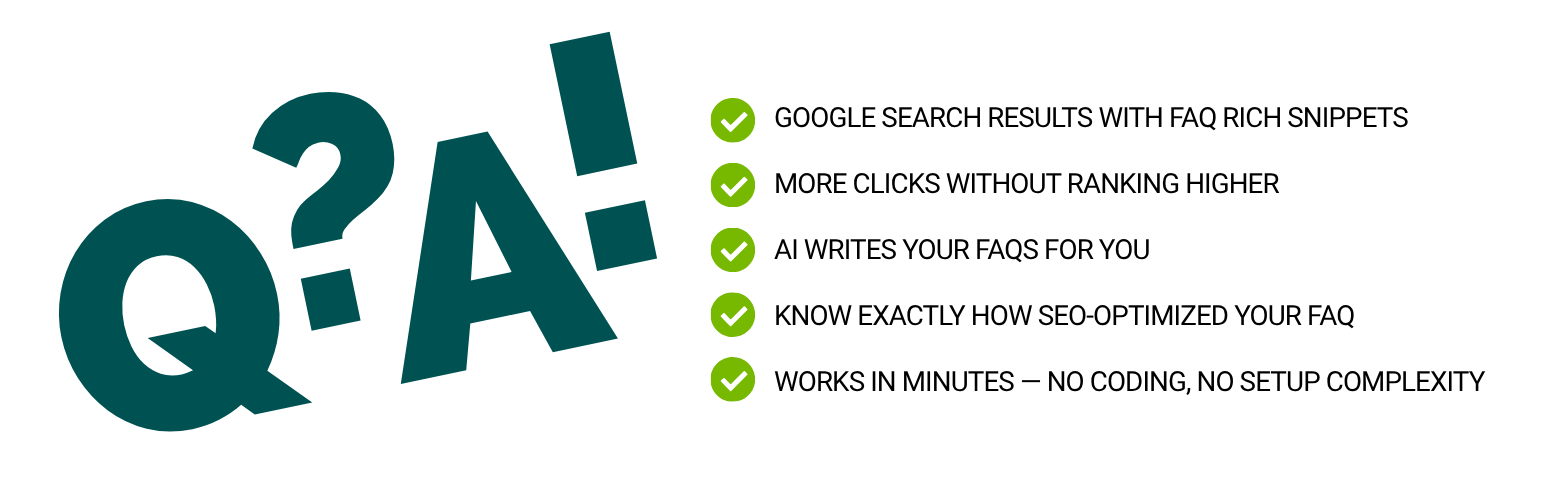
Built for AEO and GEO — get your FAQs cited by AI Overviews, ChatGPT, and Perplexity. This is an AI FAQ generator and FAQ schema plugin made for the new way people search: answer engines, not just blue links.
🪄 Fix with AI: the only FAQ plugin that scores your FAQ quality AND fixes it. Run the analyzer, click one button, and every answer is rewritten as a citation-ready 40-80 word answer capsule — direct Yes/No openers, hard data points, self-contained sentences AI engines love to quote. Watch your SEO and GEO scores jump in real time. 🌍 19-language Auto Generate. ✅ WordPress 7.0 ready.
What is AEO / GEO, and why does it matter?
Answer Engine Optimization (AEO) and Generative Engine Optimization (GEO) are about getting your content quoted by AI — Google AI Overviews, ChatGPT, Perplexity, and Claude now answer questions directly and cite their sources. AI search optimization rewards a specific structure: a direct answer in the first sentence, short 40-80 word ”answer capsules”, and concrete data points. Well-structured FAQ content is cited significantly more often in AI answers than plain prose.
This plugin generates FAQs in exactly that format, then scores each one with a dedicated GEO / AI-citation analyzer so you know how AI-ready your content is before you publish. Visible Q&A for AI engines to quote, plus valid FAQPage JSON-LD schema that Bing and the AI assistants built on its index still consume.
Write your post, add the block, hit ”Generate FAQ” — and the plugin handles everything: it reads your content, writes relevant FAQ pairs with OpenAI, and injects the schema into your page <head>. No coding.
How to add FAQ schema in WordPress
- Install and activate the plugin, then open any post or page in the block editor.
- Search for ”FAQ Schema” in the block inserter and add the block.
- Use Auto Generate (AI reads your post), paste existing FAQs in any format, or type them manually.
- Publish. Valid FAQPage JSON-LD schema is injected automatically — no shortcodes, no code.
That’s the whole setup. The schema is standards-compliant and validates on schema.org; it’s read by Bing and the AI assistants that index it, and it helps every search and answer engine understand your page.
Optimizing for AI Overviews and AI search
Ranking in AI Overviews and getting cited by ChatGPT is less about keywords and more about structure. The built-in GEO analyzer checks the exact signals answer engines reward — answer-first sentences, 40-80 word length, self-contained answers, specific data points, no filler — and Fix with AI rewrites your answers to hit all of them in one click. It’s answer engine optimization (AEO) built into your editor.
What Makes This Plugin Different
Most FAQ plugins just display pretty accordions. This one goes further:
- 🪄 Fix with AI — the only plugin that scores your FAQ quality AND rewrites your answers to pass. One click.
- ✅ AI writes the FAQs for you — one click reads your actual post content. No pasting, no templates.
- ✅ Real structured data — valid FAQPage JSON-LD, not just visual styling
- ✅ Built-in SEO quality check — 12-point analyzer tells you exactly what to improve
- ✅ GEO quality check — 8-point AI citation analyzer for AI Overview, ChatGPT, and Perplexity visibility
- ✅ 19 languages — FAQ output auto-matches your post language, or force any of 18 specific languages
- ✅ Works with any theme — no shortcodes, no theme dependency
- ✅ Zero build tools — drop it in and activate. No npm, no React, no headaches
Key Features
3 Ways to Add FAQs
- Auto Generate (AI) — One click. The plugin reads your post content directly from the editor and generates relevant FAQs — no copying, no pasting. Powered by OpenAI.
- Paste Existing FAQs — Already have FAQs? Paste them in almost any format (Q:/A:, Question:/Answer:, numbered lists, plain text, HTML, or markdown) and the smart parser auto-detects and structures them instantly.
- Manual Input — Prefer full control? Type your questions and answers directly in the block editor.
Fix with AI (NEW in 1.8.0)
Run the quality analyzer, then click Fix with AI. Every answer is rewritten as a citation-ready ”answer capsule”:
- Direct answer in the first sentence — Yes/No questions open with ”Yes,” or ”No,” plus a restated claim
- 40-80 words total, every sentence under 20 words
- At least one concrete data point per answer (numbers, dates, timeframes)
- Fully self-contained — extractable by AI engines without any page context
- Keeps your questions and your language untouched (works in all 19 supported languages)
Your SEO and GEO scores re-calculate instantly, so you see exactly what the fix accomplished.
FAQ Quality Analyzer (100-Point Score)
Before you publish, run the built-in analyzer. It checks 12 SEO criteria across 3 categories:
- Basic checks — FAQ count, duplicate detection, question format
- Direct answer quality — first-sentence scoring, search intent alignment
- Keyword SEO — keyword presence in questions and answers, sentence length, uniqueness
You get a score out of 100 with specific recommendations. No guessing what to fix.
GEO Quality Analyzer (AI Citation Score)
Optimize your FAQs for AI search engines — Google AI Overview, ChatGPT, Perplexity, and Claude. The GEO analyzer checks 8 criteria across 4 categories:
- Answer-First structure — no filler phrases, direct answers in the AI citation sweet spot (8-60 words)
- Self-Contained — no relative references, no vague endings, each FAQ stands alone
- Specificity and E-E-A-T — concrete data points, no promotional superlatives
- Clarity — no ambiguous pronouns, structured multi-sentence answers
SEO and GEO scores display side by side. Click each to see the detailed breakdown.
Google-Ready JSON-LD Schema
The plugin automatically injects valid schema.org FAQPage structured data into your page’s <head> — the standard format read by Bing and the AI assistants built on its index, and understood by every search and answer engine. You don’t touch any code.
Multiple OpenAI Models
Choose the model that fits your needs and budget:
gpt-4o-mini— Fastest, lowest cost. Great for most blogs.gpt-4o— Multimodal flagship, balanced quality and cost.gpt-4.1-mini— Upgraded mini with a larger context window.gpt-4.1— Flagship model. Best quality for competitive niches.o3-mini— Reasoning model. Good for complex topics.o3— Most capable reasoning model.o4-mini— Latest lightweight reasoning model.
7 Display Styles
- Minimal — Clean text list with Q prefix
- Card — Elevated cards with hover effects
- Accordion — Click to expand, great for long answers
- Boxed — Colored header with distinct sections
- Timeline — Vertical timeline with numbered dots
- Chat Bubble — Messenger-style question/answer bubbles
- Numbered — Large index numbers for tutorial-style posts
Dark Mode
All display styles automatically adapt to your visitor’s OS preference — readers using dark mode see a matching dark-themed FAQ block with no extra configuration.
Custom AI Prompt
Not happy with the default output? Edit the prompt. Use {count} as a placeholder for the number of FAQs. The plugin always enforces JSON formatting automatically.
Target Keyword Optimization
Set a target keyword per block (or let AI detect it from your content). The quality analyzer then checks whether your FAQs are properly optimized around that keyword.
Who Is This For?
- Bloggers who want more Google visibility without touching code
- SEO professionals who need to scale FAQ structured data across many posts
- Content marketers building topical authority in competitive niches
- Agencies managing client sites and needing a reliable FAQ solution
- Small business sites looking to get their answers surfaced and cited in AI search (AI Overviews, ChatGPT)
Security
Your OpenAI API key is stored server-side and never exposed to the browser. All AI calls happen through a protected REST endpoint with nonce verification. Rate limiting (10 requests/minute/user) prevents abuse.
External Services
This plugin connects to the OpenAI API (api.openai.com) to generate FAQ content, rewrite answers (Fix with AI), and extract target keywords.
When you click ”Generate FAQ,” ”Fix with AI,” or ”AI Detect,” your post content, your FAQ text, and the prompt are sent to OpenAI’s servers for processing. This only happens on demand — never automatically in the background.